MoreExam
1. Question Content...
EXPLANATION
Answer: X - EXPLANATION Content.
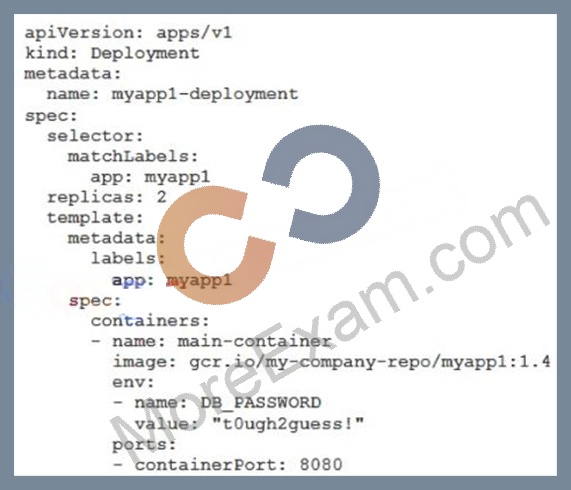
Question1: You deployed a new application inside your Google Kubernetes Engine cluster using the YAML file specified below.You check the status of the deployed pods and notice that one of them is still in PENDING status:You want to find out why the pod is stuck in pending status. What should you do?
Question2: You are deploying an application to App Engine. You want the number of instances to scale based on request rate. You need at least 3 unoccupied instances at all times. Which scaling type should you use?
Question3: You are designing an application that uses WebSockets and HTTP sessions that are not distributed across the web servers. You want to ensure the application runs properly on Google Cloud Platform. What should you do?
Question4: You are designing an application that lets users upload and share photos. You expect your application to grow really fast and you are targeting a worldwide audience. You want to delete uploaded photos after 30 days. You want to minimize costs while ensuring your application is highly available. Which GCP storage solution should you choose?
Question5: You need to create a custom IAM role for use with a GCP service. All permissions in the role must be suitable for production use. You also want to clearly share with your organization the status of the custom role. This will be the first version of the custom role. What should you do?
Question6: You host a static website on Cloud Storage. Recently, you began to include links to PDF files on this site. Currently, when users click on the links to these PDF files, their browsers prompt them to save the file onto their local system. Instead, you want the clicked PDF files to be displayed within the browser window directly, without prompting the user to save the file locally. What should you do?
Question7: You need to reduce GCP service costs for a division of your company using the fewest possible steps. You need to turn off all configured services in an existing GCP project. What should you do?
Question8: You are the project owner of a GCP project and want to delegate control to colleagues to manage buckets and files in Cloud Storage. You want to follow Google-recommended practices. Which IAM roles should you grant your colleagues?
Question9: Your web application has been running successfully on Cloud Run for Anthos. You want to evaluate an updated version of the application with a specific percentage of your production users (canary deployment). What should you do?
Question10: Your organization is a financial company that needs to store audit log files for 3 years. Your organization has hundreds of Google Cloud projects. You need to implement a cost-effective approach for log file retention. What should you do?
Question11: You are hosting an application from Compute Engine virtual machines (VMs) in us-central1- a. You want to adjust your design to support the failure of a single Compute Engine zone, eliminate downtime, and minimize cost. What should you do?
Question12: You need to set up permissions for a set of Compute Engine instances to enable them to write data into a particular Cloud Storage bucket. You want to follow Google-recommended practices. What should you do?
Question13: You have a batch workload that runs every night and uses a large number of virtual machines (VMs). It is fault- tolerant and can tolerate some of the VMs being terminated. The current cost of VMs is too high. What should you do?
Question14: Your organization has three existing Google Cloud projects. You need to bill the Marketing department for only their Google Cloud services for a new initiative within their group. What should you do?
Question15: You need to create a copy of a custom Compute Engine virtual machine (VM) to facilitate an expected increase in application traffic due to a business acquisition. What should you do?
Question16: You need to create a new billing account and then link it with an existing Google Cloud Platform project. What should you do?
Question17: Users of your application are complaining of slowness when loading the application. You realize the slowness is because the App Engine deployment serving the application is deployed in us-central whereas all users of this application are closest to europe-west3. You want to change the region of the App Engine application to europe-west3 to minimize latency. What's the best way to change the App Engine region?
Question18: Your learn wants to deploy a specific content management system (CMS) solution lo Google Cloud. You need a quick and easy way to deploy and install the solution. What should you do?
Question19: You have created an application that is packaged into a Docker image. You want to deploy the Docker image as a workload on Google Kubernetes Engine. What should you do?
Question20: A company wants to build an application that stores images in a Cloud Storage bucket and wants to generate thumbnails as well as resize the images. They want to use a google managed service that can scale up and scale down to zero automatically with minimal effort. You have been asked to recommend a service. Which GCP service would you suggest?
Question21: You need to verify that a Google Cloud Platform service account was created at a particular time. What should you do?
Question22: You have been asked to set up the billing configuration for a new Google Cloud customer. Your customer wants to group resources that share common IAM policies. What should you do?
Question23: You want to set up a Google Kubernetes Engine cluster Verifiable node identity and integrity are required for the cluster, and nodes cannot be accessed from the internet. You want to reduce the operational cost of managing your cluster, and you want to follow Google-recommended practices. What should you do?
Question24: You are building a pipeline to process time-series data. Which Google Cloud Platform services should you put in boxes 1,2,3, and 4?
Question25: Your organization uses G Suite for communication and collaboration. All users in your organization have a G Suite account. You want to grant some G Suite users access to your Cloud Platform project. What should you do?
Question26: Your company has a large quantity of unstructured data in different file formats. You want to perform ETL transformations on the dat a. You need to make the data accessible on Google Cloud so it can be processed by a Dataflow job. What should you do?
Question27: You need to manage multiple Google Cloud Platform (GCP) projects in the fewest steps possible. You want to configure the Google Cloud SDK command line interface (CLI) so that you can easily manage multiple GCP projects. What should you?
Question28: You have a managed instance group comprised of preemptible VM's. All of the VM's keepdeleting and recreating themselves every minute. What is a possible cause of thisbehavior?
Question29: You are analyzing Google Cloud Platform service costs from three separate projects. You want to use this information to create service cost estimates by service type, daily and monthly, for the next six months using standard query syntax. What should you do?
Question30: You installed the Google Cloud CLI on your workstation and set the proxy configuration. However, you are worried that your proxy credentials will be recorded in the gcloud CLI logs. You want to prevent your proxy credentials from being logged What should you do?
Question31: You are configuring Cloud DNS. You want !to create DNS records to point home.mydomain.com, mydomain.com. and www.mydomain.com to the IP address of your Google Cloud load balancer. What should you do?
Question32: You created a Kubernetes deployment by running kubectl run nginx image=nginx labels=app=prod. Your Kubernetes cluster is also used by a number of other deployments. How can you find the identifier of the pods for this nginx deployment?
Question33: You need to create a custom VPC with a single subnet. The subnet's range must be as large as possible. Which range should you use?
Question34: Your company has an internal application for managing transactional orders. The application is used exclusively by employees in a single physical location. The application requires strong consistency, fast queries, and ACID guarantees for multi-table transactional updates. The first version of the application is implemented inPostgreSQL, and you want to deploy it to the cloud with minimal code changes. Which database is most appropriate for this application?
Question35: Your managed instance group raised an alert stating that new instance creation has failed to create new instances. You need to maintain the number of running instances specified by the template to be able to process expected application traffic. What should you do?
Question36: You want to add a new auditor to a Google Cloud Platform project. The auditor should be allowed to read, but not modify, all project items.How should you configure the auditor's permissions?
Question37: You are building an application that processes data files uploaded from thousands of suppliers. Your primary goals for the application are data security and the expiration of aged dat a. You need to design the application to:* Restrict access so that suppliers can access only their own data.* Give suppliers write access to data only for 30 minutes.* Delete data that is over 45 days old.You have a very short development cycle, and you need to make sure that the application requires minimal maintenance. Which two strategies should you use? (Choose two.)
Question38: Your organization needs to grant users access to query datasets in BigQuery but prevent them from accidentally deleting the datasets. You want a solution that follows Google-recommended practices. What should you do?
Question39: You have a web application deployed as a managed instance group. You have a new version of the application to gradually deploy. Your web application is currently receiving live web traffic. You want to ensure that the available capacity does not decrease during the deployment. What should you do?
Question40: You have a website hosted on App Engine standard environment. You want 1% of your users to see a new test version of the website. You want to minimize complexity. What should you do?
Question41: You need to grant access for three users so that they can view and edit table data on a Cloud Spanner instance. What should you do?
Question42: For analysis purposes, you need to send all the logs from all of your Compute Engine instances to a BigQuery dataset called platform-logs. You have already installed the Stackdriver Logging agent on all the instances. You want to minimize cost. What should you do?
Question43: You need to provide a cost estimate for a Kubernetes cluster using the GCP pricing calculator for Kubernetes. Your workload requires high IOPs, and you will also be using disk snapshots. You start by entering the number of nodes, average hours, and average days. What should you do next?
Question44: You recently deployed a new version of an application to App Engine and then discovered a bug in the release. You need to immediately revert to the prior version of the application. What should you do?
Question45: You want to configure autohealing for network load balancing for a group of Compute Engine instances that run in multiple zones, using the fewest possible steps. You need to configure re-creation of VMs if they are unresponsive after 3 attempts of 10 seconds each. What should you do?
Question46: Your company completed the acquisition of a startup and is now merging the IT systems of both companies. The startup had a production Google Cloud project in their organization. You need to move this project into your organization and ensure that the project is billed lo your organization. You want to accomplish this task with minimal effort. What should you do?
Question47: You built an application on your development laptop that uses Google Cloud services. Your application uses Application Default Credentials for authentication and works fine on your development laptop. You want to migrate this application to a Compute Engine virtual machine (VM) and set up authentication using Google- recommended practices and minimal changes. What should you do?
Question48: You have one GCP account running in your default region and zone and another account running in a non-default region and zone. You want to start a new Compute Engine instance in these two Google Cloud Platform accounts using the command line interface. What should you do?
Question49: Your finance team wants to view the billing report for your projects. You want to make sure that the finance team does not get additional permissions to the project. What should you do?
Question50: You need to enable traffic between multiple groups of Compute Engine instances that are currently running two different GCP projects. Each group of Compute Engine instances is running in its own VPC. What should you do?
Question51: You have developed an application that consists of multiple microservices, with each microservice packaged in its own Docker container image. You want to deploy the entire application on Google Kubernetes Engine so that each microservice can be scaled individually. What should you do?
Question52: An external member of your team needs list access to compute images and disks in one of your projects. You want to follow Google-recommended practices when you grant the required permissions to this user. What should you do?
Question53: You have designed a solution on Google Cloud Platform (GCP) that uses multiple GCP products. Your company has asked you to estimate the costs of the solution. You need to provide estimates for the monthly total cost. What should you do?
Question54: You want to configure an SSH connection to a single Compute Engine instance for users in the dev1 group. This instance is the only resource in this particular Google Cloud Platform project that the dev1 users should be able to connect to. What should you do?
Question55: Your company developed a mobile game that is deployed on Google Cloud. Gamers are connecting to the game with their personal phones over the Internet. The game sends UDP packets to update the servers about the gamers' actions while they are playing in multiplayer mode. Your game backend can scale over multiple virtual machines (VMs), and you want to expose the VMs over a single IP address. What should you do?
Question56: You need to add a group of new users to Cloud Identity. Some of the users already have existing Google accounts. You want to follow one of Google's recommended practices and avoid conflicting accounts. What should you do?
Question57: You are deploying a production application on Compute Engine. You want to prevent anyone from accidentally destroying the instance by clicking the wrong button. What should you do?
Question58: An employee was terminated, but their access to Google Cloud Platform (GCP) was not removed until 2 weeks later. You need to find out this employee accessed any sensitive customer information after their termination. What should you do?
Question59: You have been asked to set up Object Lifecycle Management for objects stored in storage buckets. The objects are written once and accessed frequently for 30 days. After 30 days, the objects are not read again unless there is a special need. The object should be kept for three years, and you need to minimize cost. What should you do?
Question60: Your company has multiple projects linked to a single billing account in Google Cloud. You need to visualize the costs with specific metrics that should be dynamically calculated based on company-specific criteria. You want to automate the process. What should you do?
Question61: You have an application that uses Cloud Spanner as a database backend to keep current state information about users. Cloud Bigtable logs all events triggered by users. You export Cloud Spanner data to Cloud Storage during daily backups. One of your analysts asks you to join data from Cloud Spanner and Cloud Bigtable for specific users. You want to complete this ad hoc request as efficiently as possible. What should you do?
Question62: You have developed a containerized web application that will serve Internal colleagues during business hours. You want to ensure that no costs are incurred outside of the hours the application is used. You have just created a new Google Cloud project and want to deploy the application. What should you do?
Question63: You've deployed a microservice called myapp1 to a Google Kubernetes Engine cluster using the YAML file specified below:You need to refactor this configuration so that the database password is not stored in plain text. You want to follow Google-recommended practices. What should you do?
Question64: You are running a data warehouse on BigQuery. A partner company is offering a recommendation engine based on the data in your data warehouse. The partner company is also running their application on Google Cloud. They manage the resources in their own project, but they need access to the BigQuery dataset in your project. You want to provide the partner company with access to the dataset What should you do?
Question65: You are managing a Data Warehouse on BigQuery. An external auditor will review your company's processes, and multiple external consultants will need view access to the data. You need to provide them with view access while following Google-recommended practices. What should you do?
Question66: A colleague handed over a Google Cloud Platform project for you to maintain. As part of a security checkup, you want to review who has been granted the Project Owner role. What should you do?
Question67: You are using Container Registry to centrally store your company's container images in a separate project. In another project, you want to create a Google Kubernetes Engine (GKE) cluster. You want to ensure that Kubernetes can download images from Container Registry. What should you do?
Question68: You want to deploy an application on Cloud Run that processes messages from a Cloud Pub/Sub topic. You want to follow Google-recommended practices. What should you do?
Question69: You are working for a hospital that stores Its medical images in an on-premises data room. The hospital wants to use Cloud Storage for archival storage of these images. The hospital wants an automated process to upload any new medical images to Cloud Storage. You need to design and implement a solution. What should you do?
Question70: You create a Deployment with 2 replicas in a Google Kubernetes Engine cluster that has a single preemptible node pool. After a few minutes, you use kubectl to examine the status of your Pod and observe that one of them is still in Pending status:What is the most likely cause?
Question71: You have an application that looks for its licensing server on the IP 10.0.3.21. You need to deploy the licensing server on Compute Engine. You do not want to change the configuration of the application and want the application to be able to reach the licensing server. What should you do?
Question72: The core business of your company is to rent out construction equipment at a large scale. All the equipment that is being rented out has been equipped with multiple sensors that send event information every few seconds. These signals can vary from engine status, distance traveled, fuel level, and more. Customers are billed based on the consumption monitored by these sensors. You expect high throughput - up to thousands of events per hour per device - and need to retrieve consistent data based on the time of the event. Storing and retrieving individual signals should be atomic. What should you do?
Question73: You have an instance group that you want to load balance. You want the load balancer to terminate the client SSL session. The instance group is used to serve a public web application over HTTPS. You want to follow Google-recommended practices. What should you do?
Question74: Your company uses Cloud Storage to store application backup files for disaster recovery purposes. You want to follow Google's recommended practices. Which storage option should you use?
Question75: You are about to deploy a new Enterprise Resource Planning (ERP) system on Google Cloud. The application holds the full database in-memory for fast data access, and you need to configure the most appropriate resources on Google Cloud for this application. What should you do?
Question76: You have an application on a general-purpose Compute Engine instance that is experiencing excessive disk read throttling on its Zonal SSD Persistent Disk. The application primarily reads large files from disk. The disk size is currently 350 GB. You want to provide the maximum amount of throughput while minimizing costs. What should you do?
Question77: You are building a new version of an application hosted in an App Engine environment. You want to test the new version with 1% of users before you completely switch your application over to the new version. What should you do?
Question78: You are building a product on top of Google Kubernetes Engine (GKE). You have a single GKE cluster. For each of your customers, a Pod is running in that cluster, and your customers can run arbitrary code inside their Pod. You want to maximize the isolation between your customers' Pods. What should you do?
Question79: You have a development project with appropriate IAM roles defined. You are creating a production project and want to have the same IAM roles on the new project, using the fewest possible steps. What should you do?
Question80: You are developing a new web application that will be deployed on Google Cloud Platform. As part of your release cycle, you want to test updates to your application on a small portion of real user traffic. The majority of the users should still be directed towards a stable version of your application. What should you do?
Question81: Your company has a single sign-on (SSO) identity provider that supports Security Assertion Markup Language (SAML) integration with service providers. Your company has users in Cloud Identity. You would like users to authenticate using your company's SSO provider. What should you do?
Question82: Your Dataproc cluster runs in a single Virtual Private Cloud (VPC) network in a single subnet with range 172.16.20.128/25. There are no private IP addresses available in the VPC network. You want to add new VMs to communicate with your cluster using the minimum number of steps. What should you do?
Question83: You want to verify the IAM users and roles assigned within a GCP project named my-project. What should you do?
Question84: You created an instance of SQL Server 2017 on Compute Engine to test features in the new version. You want to connect to this instance using the fewest number of steps. What should you do?
Question85: You are using Data Studio to visualize a table from your data warehouse that is built on top of BigQuery. Data is appended to the data warehouse during the day. At night, the daily summary is recalculated by overwriting the table. You just noticed that the charts in Data Studio are broken, and you want to analyze the problem. What should you do?
Question86: You are configuring service accounts for an application that spans multiple projects. Virtual machines (VMs) running in the web-applications project need access to BigQuery datasets in crm-databases-proj. You want to follow Google-recommended practices to give access to the service account in the web-applications project. What should you do?
Question87: Your auditor wants to view your organization's use of data in Google Cloud. The auditor is most interested in auditing who accessed data in Cloud Storage buckets. You need to help the auditor access the data they need. What should you do?
Question88: You are deploying an application to a Compute Engine VM in a managed instance group. The application must be running at all times, but only a single instance of the VM should run per GCP project. How should you configure the instance group?
Question89: You are managing a project for the Business Intelligence (BI) department in your company. A data pipeline ingests data into BigQuery via streaming. You want the users in the BI department to be able to run the custom SQL queries against the latest data in BigQuery. What should you do?
Question90: You are running multiple microservices in a Kubernetes Engine cluster. One microservice is rendering images. The microservice responsible for the image rendering requires a large amount of CPU time compared to the memory it requires. The other microservices are workloads that are optimized for n1-standard machine types. You need to optimize your cluster so that all workloads are using resources as efficiently as possible. What should you do?
Question91: You have deployed multiple Linux instances on Compute Engine. You plan on adding more instances in the coming weeks. You want to be able to access all of these instances through your SSH client over me Internet without having to configure specific access on the existing and new instances. You do not want the Compute Engine instances to have a public IP. What should you do?
Question92: You built an application on Google Cloud Platform that uses Cloud Spanner. Your support team needs to monitor the environment but should not have access to table dat a. You need a streamlined solution to grant the correct permissions to your support team, and you want to follow Google-recommended practices. What should you do?
Question93: You manage three Google Cloud projects with the Cloud Monitoring API enabled. You want to follow Google-recommended practices to visualize CPU and network metrics for all three projects together. What should you do?
Question94: Your projects incurred more costs than you expected last month. Your research reveals that a development GKE container emitted a huge number of logs, which resulted in higher costs. You want to disable the logs quickly using the minimum number of steps. What should you do?
Question95: You are building a data lake on Google Cloud for your Internet of Things (loT) application. The loT application has millions of sensors that are constantly streaming structured and unstructured data to your backend in the cloud. You want to build a highly available and resilient architecture based on Google-recommended practices. What should you do?
Question96: You need to produce a list of the enabled Google Cloud Platform APIs for a GCP project using the gcloud command line in the Cloud Shell. The project name is my-project. What should you do?
Question97: You have production and test workloads that you want to deploy on Compute Engine. Production VMs need to be in a different subnet than the test VMs. All the VMs must be able to reach each other over internal IP without creating additional routes. You need to set up VPC and the 2 subnets. Which configuration meets these requirements?
Question98: You are the organization and billing administrator for your company. The engineering team has the Project Creator role on the organization. You do not want the engineering team to be able to link projects to the billing account. Only the finance team should be able to link a project to a billing account, but they should not be able to make any other changes to projects. What should you do?
Question99: You are assisting a new Google Cloud user who just installed the Google Cloud SDK on their VM. The server needs access to Cloud Storage. The user wants your help to create a new storage bucket. You need to make this change in multiple environments. What should you do?
Question100: You created a Google Cloud Platform project with an App Engine application inside the project. You initially configured the application to be served from the us-central region. Now you want the application to be served from the asia-northeast1 region. What should you do?
Question101: Your company implemented BigQuery as an enterprise data warehouse. Users from multiple business units run queries on this data warehouse. However, you notice that query costs for BigQuery are very high, and you need to control costs. Which two methods should you use? (Choose two.)
Question102: Your company has embraced a hybrid cloud strategy where some of the applications are deployed on Google Cloud. A Virtual Private Network (VPN) tunnel connects your Virtual Private Cloud (VPC) in Google Cloud with your company's on-premises network. Multiple applications in Google Cloud need to connect to an on-premises database server, and you want to avoid having to change the IP configuration in all of your applications when the IP of the database changes.What should you do?
Question103: You manage an App Engine Service that aggregates and visualizes data from BigQuery. The application is deployed with the default App Engine Service account. The data that needs to be visualized resides in a different project managed by another team. You do not have access to this project, but you want your application to be able to read data from the BigQuery dataset. What should you do?
Question104: Your team is using Linux instances on Google Cloud. You need to ensure that your team logs in to these instances in the most secure and cost efficient way. What should you do?
Question105: Your company is using Google Workspace to manage employee accounts. Anticipated growth will increase the number of personnel from 100 employees to 1.000 employees within 2 years. Most employees will need access to your company's Google Cloud account. The systems and processes will need to support 10x growth without performance degradation, unnecessary complexity, or security issues. What should you do?
Question106: You have created a new project in Google Cloud through the gcloud command line interface (CLI) and linked a billing account. You need to create a new Compute Engine instance using the CLI. You need to perform the prerequisite steps. What should you do?